Talk to your vet before a long flight: calming aids and sedation for dogs
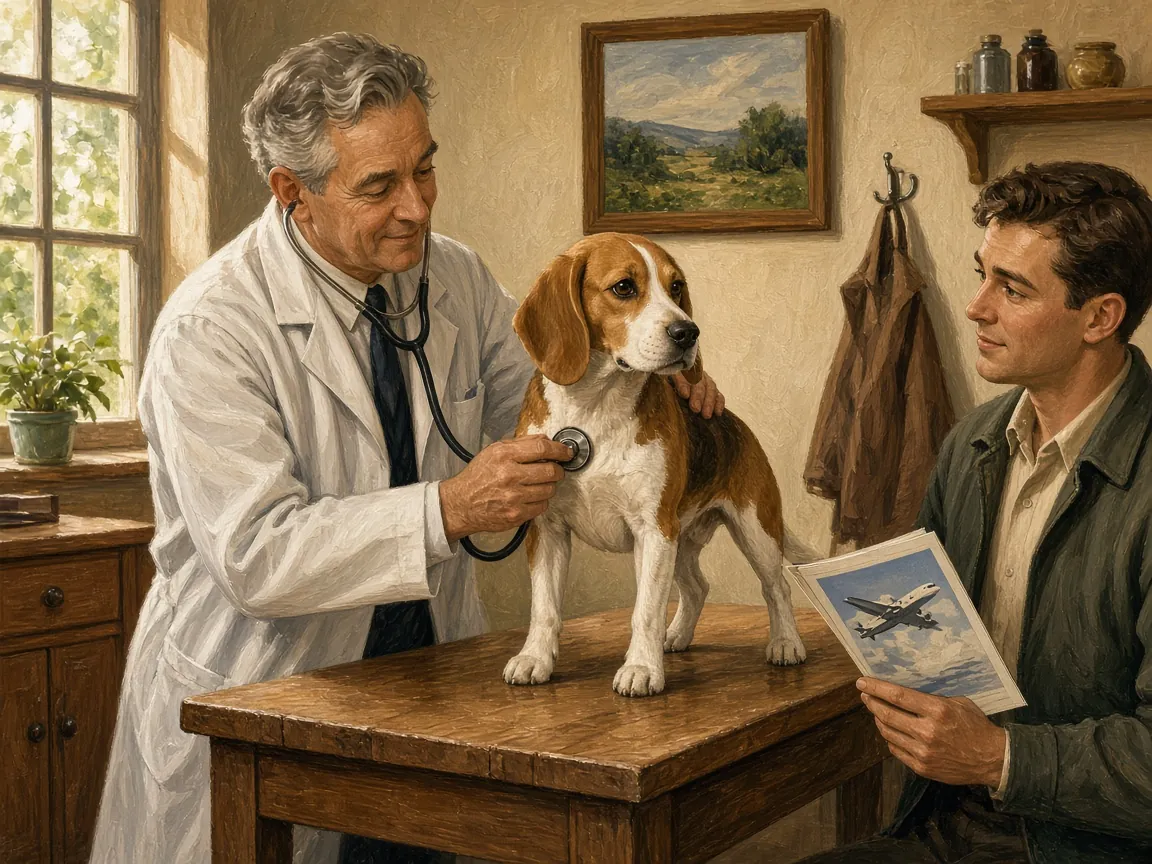
Long flights are stressful for many dogs, and it is natural to ask your vet for "something to help them sleep." This guide explains why that conversation matters, what vets and airlines actually say about sedation, and which non-drug options you can prepare well before travel day. It does not recommend any drug or dose: that decision belongs to your veterinarian, who knows your dog.
Confirm with your airline and your vet. Airline and government rules change often. This guide summarizes official and veterinary sources checked on 24 November 2026. It is not veterinary or legal advice. Before you book, confirm the current rule with your airline and talk to your veterinarian about your dog's health.
Start with a vet visit, not a pill
The first step is a health check, booked as soon as you know your travel dates. The American Veterinary Medical Association (AVMA) suggests scheduling a veterinary examination to make sure your pet is healthy enough for travel (AVMA). It also asks owners to consider first whether travel is right for the pet at all, because illness, injury or temperament can make it uncomfortable (AVMA).
Airlines say the same. WestJet tells owners not to give any tranquilizer or other medication before travel without first consulting a veterinarian (WestJet). Air North recommends consulting your veterinarian before travelling to make sure your pet is healthy and ready for air travel (Air North).
Use the appointment to cover:
- Fitness to fly. Does your dog have a heart, airway or other condition that makes flying risky?
- Your route. Cabin or hold? How long is the longest leg? Our trip wizard shows which airlines can take your dog, and how, for your route and weight.
- Anxiety history. How does your dog cope with car rides, the clinic, or being confined?
- Paperwork. Many routes need a vet-signed document. For example, Mexico requires a screwworm inspection certificate for dogs arriving from the US (USDA APHIS). See our government rules page.
A survey of 635 owners whose dogs had flown in the previous 12 months found that over half did not seek professional advice. Stress-management products were used for only about a quarter of the dogs (Jahn et al., Animals, 2023). Planning early with your vet is the gap most travelers can close.
What the AVMA says about sedatives
The AVMA's air-travel guidance is direct: "Consult your veterinarian before giving your pet any tranquilizers or sedatives. These can increase the risk of heart or respiratory problems and generally are not allowed by airlines" (AVMA; same text in the AVMA client brochure).
The AVMA also warns that brachycephalic (short-nosed) pets are more at risk of overheating or breathing problems during travel, "especially air travel" (AVMA).
What IATA says
The International Air Transport Association (IATA) writes the Live Animals Regulations that airlines use. On its traveler page, IATA says it has long been the practice of IATA and its airlines to discourage sedatives and tranquilizers for animals carried as cargo or as cabin baggage, because of possible adverse effects during transport. It adds that the AVMA endorses this view (IATA).
IATA explains the risks. Sedated animals can lose their balance and their ability to position themselves, which exposes them to injury and to airway obstruction from abnormal postures. Using these drugs without frequent or continual observation can threaten the animal's life (IATA).
IATA does allow one exception. If sedation is done for valid medical reasons, it must be done under a veterinarian's direction, and the drug, time and dose must be noted on the health certificate (IATA). This is the "rare" case, and it is a veterinary decision, not an owner's.
What other veterinary bodies say
The Australian Veterinary Association (AVA) policy on medicating dogs and cats for air transport is the most detailed public statement we found (AVA):
- "Dogs and cats should not be sedated for air transport."
- Cabins and cargo holds are typically pressurized to about 8,000 feet. Sedation can lower blood pressure, heart rate and breathing rate, which can lead to cardiovascular and respiratory collapse.
- Sedation can reduce an animal's ability to regulate its body temperature.
- In the cargo hold, animals cannot be reached during the flight, so no treatment is possible if complications arise.
- Sedation does not reduce the anxiety the animal feels, and some animals become more excitable once it wears off.
- However, non-sedating anti-anxiety or anti-nausea medication may be appropriate in some cases. Most medications used only for travel should be tried out before the trip under veterinary advice.
That last point is why the vet visit matters. What your vet may suggest is different from "knocking the dog out," and only your vet can judge it.
What airlines say
We read the pet pages of every North American airline in our airline directory. Here is what they publish about sedation:
| Airline | Published position | Source |
|---|---|---|
| American Airlines | "As recommended by the American Veterinary Medical Association (AVMA), we don't accept pets that have been sedated or tranquilized." | aa.com |
| Air Canada | "Tranquilizers and other medications are not recommended. Consult your veterinarian." | aircanada.com |
| WestJet | Don't give any tranquilizer or other medication before travel without first consulting a veterinarian. | westjet.com |
| Volaris | "Don't sedate your pet": it raises the risk of cardiac or respiratory problems, citing AVMA and IATA. | volaris.com |
| PAL Airlines | Does not recommend tranquilizers. A tranquilized pet needs vet documentation at check-in. | palairlines.ca |
| Air North | Generally does not recommend sedation (it can affect heart rate, breathing and oxygen intake). A sedated animal needs a vet certificate of fitness. | flyairnorth.com |
| Perimeter Aviation | In cold-weather hold travel, "The pet must not be sedated. Sedated animals do not maintain their body temperatures." | perimeter.ca |
| Central Mountain Air | Will not accept animals "so heavily sedated that they cannot stand up." | flycma.com |
Mexico has a legal rule, not only an airline policy. Article 107, section XI of the Civil Aviation Regulation says: "Los animales domésticos no podrán ser sedados por ningún motivo" (domestic animals may not be sedated for any reason) (DOF, Reglamento de la Ley de Aviación Civil). It applies to Mexican carriers such as Aeroméxico, Viva Aerobus and Volaris.
The pattern: no airline we checked encourages sedation. One refuses sedated pets outright, several need vet paperwork, and Mexico bans it by regulation. A sedated dog can be refused at check-in.
Why the risks are higher in cargo and for snub-nosed dogs
Temperature and supervision. A dog in the hold cannot be checked or helped during the flight (AVA). Sedation also impairs temperature control (AVA; Perimeter Aviation). Many large airlines no longer take pets in the hold at all. American, Delta and United carry checked or cargo pets only for US military or State Department travelers on orders (research summary).
Short-nosed breeds. The AVA says the US Department of Transportation advised that half of all dogs that died during air transport from 2005 to 2010 were brachycephalic, and that sedation further increases the risks for these dogs (AVA). Several airlines ban snub-nosed dogs from the hold. See our guide to snub-nosed breeds and airline bans.
Non-drug options to prepare (start weeks ahead)
1. Crate or carrier training
This is the most widely recommended step. The AVMA advises getting your pet used to the crate or carrier ahead of time, and says a familiar toy or blanket inside can help (AVMA). IATA says to let the animal become familiar with the crate a few weeks or months before departure (IATA). WestJet recommends helping your pet learn that the kennel is a safe space long before travel (WestJet).
A practical progression to discuss with your vet or a trainer:
- Leave the carrier open at home with bedding and treats inside.
- Feed meals near it, then inside it.
- Close the door for short, calm periods, and build up slowly.
- Carry the closed carrier around the house, then take short car trips.
- Practice sitting with the carrier at your feet, the way it will sit under the seat.
First, buy a carrier that meets your airline's size rule. See our carrier size guide by airline.
2. A calm, dim environment
For a pet travelling in the hold, IATA suggests checking in early so it can be taken to the baggage area and kept somewhere quiet and dimly lit to relax (IATA). The AVA recommends that animals travel with their own bedding and familiar scents (AVA).
3. Pheromones
Synthetic dog-appeasing pheromone products (sprays, diffusers, collars) mimic calming pheromones produced by nursing dogs. They have been used for anxiety related to car rides and vet visits (Merck Veterinary Manual). The AVA says pheromone products "may help reduce anxiety" (AVA). Merck also notes that evidence for natural products in dogs is "somewhat limited" (Merck Veterinary Manual). Treat pheromones as one helper, not a guarantee.
4. Supplements: only with your vet's approval
Calming chews and supplements are widely sold. VCA Animal Hospitals warns that "just because a product is natural does not mean that it is safe," that supplements can have side effects, and that your veterinarian is the best source of information on their safety (VCA). VCA's behavior specialists add that purity and strength can vary between brands and even batches, so you should consult your veterinary team before using any non-prescription product (VCA). Tell your vet about everything you plan to give, including anything "natural."
5. Exercise and timing
The AVMA suggests exercising your pet before entering the airport and checking in as late as possible when your pet travels in the cabin, so it spends less time in the busy terminal (AVMA brochure). Ask your vet about feeding. The AVMA recommends talking to your veterinarian about whether and when to feed before, during and after the flight (AVMA). Some airlines publish their own timing. WestJet asks for a light meal and water within the four hours before check-in (WestJet). Our day-of-flight checklist puts it all in order.
Questions to ask your vet
- Is my dog healthy enough to fly this route, in the cabin or in the hold?
- Is my dog's breed or airway a concern?
- Would any medication help my dog, and is it sedating? (Remember IATA's and the airlines' positions.)
- If you recommend something, should we try it at home before the trip?
- Are pheromones or supplements safe alongside my dog's current medications?
- Which travel documents can you sign, and when? (Some must be issued within a few days of the flight.)
- Should I change feeding before the flight?
The bottom line
- See your vet early. They may suggest calming aids, and only rarely, for a valid medical reason, a sedative. That is their decision, documented properly.
- The AVMA, IATA and the AVA all advise against routine sedation for flights. American Airlines refuses sedated pets, and Mexico bans sedation by regulation.
- Crate training, a calm setup, familiar bedding and good timing are the evidence-backed basics. Pheromones and supplements are add-ons, and supplements need your vet's approval.
Next steps: compare airlines in our directory, run the trip wizard for your document checklist, and read the FAQ.
Frequently asked questions
- Can I give my dog a sedative before a flight?
- Not on your own. The AVMA says to consult your veterinarian before giving any tranquilizer or sedative because they can increase the risk of heart or respiratory problems and are generally not allowed by airlines. IATA discourages sedation in the cabin and in cargo. American Airlines does not accept sedated or tranquilized pets, and Mexico's civil aviation regulation says domestic animals may not be sedated for any reason.
- Will my vet prescribe something for flight anxiety?
- Your vet decides. The Australian Veterinary Association says dogs should not be sedated for air transport, but that non-sedating anti-anxiety or anti-nausea medication may be appropriate for some animals, ideally trialled before the trip under veterinary advice. Only your vet can say whether your dog needs anything and what.
- Why is sedation riskier for snub-nosed dogs?
- The AVMA says short-nosed pets are more at risk of overheating or breathing problems during air travel, and the AVA says sedation further increases the risks for brachycephalic dogs.
- Do pheromone sprays or calming supplements work?
- Evidence is limited. The Merck Veterinary Manual notes that evidence for natural products in dogs is somewhat limited, although several studies support pheromone therapy. VCA Animal Hospitals warns that 'natural' does not guarantee safety and that you should consult your veterinary team before using any non-prescription product.
- What is the safest way to calm a dog for a flight?
- Preparation. The AVMA recommends getting your dog used to the crate or carrier ahead of time, and IATA says to let the animal become familiar with the crate a few weeks or months before departure. A vet check before booking is the starting point.
Airline pages mentioned
american · aircanada · westjet · volaris · pal · airnorth · Trip wizard · All guides