DOT service animal forms explained: what US airlines can and cannot ask for
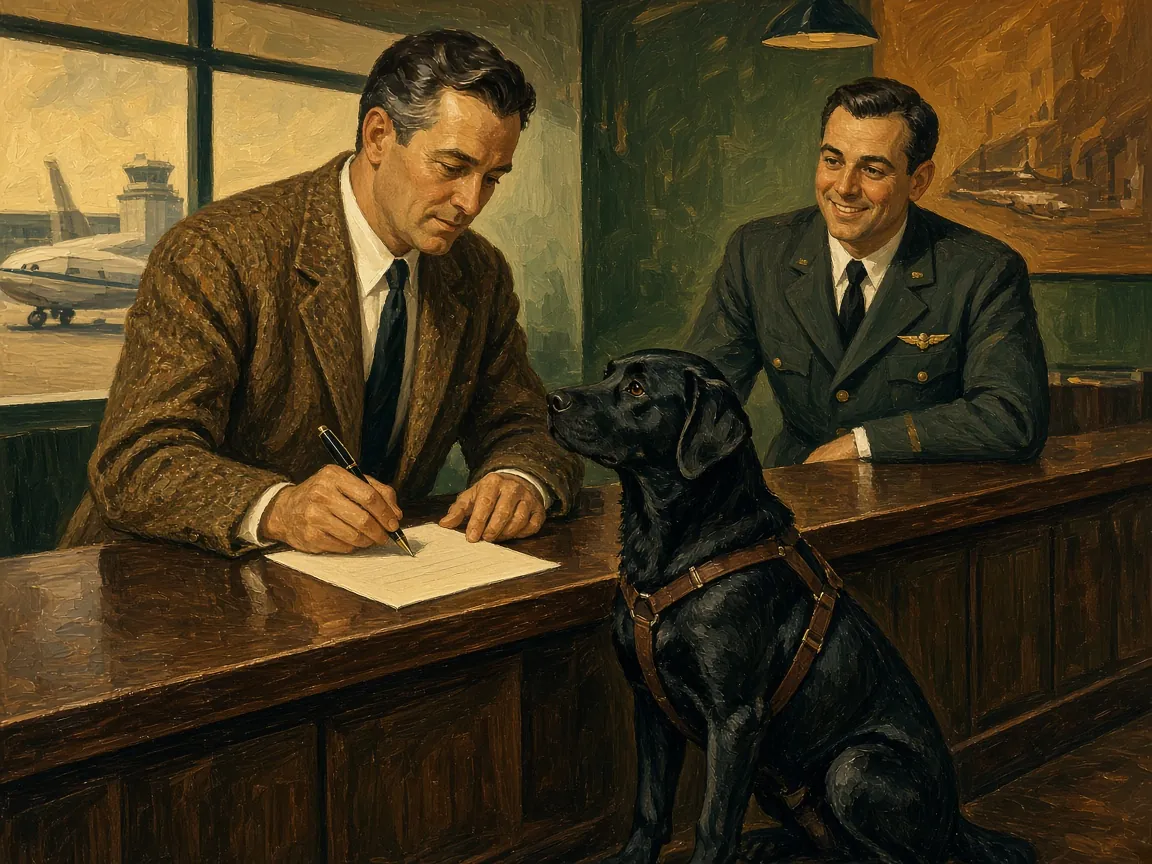
If you fly to, from or within the United States with a trained service dog, the airline can ask you for paperwork. It can't ask for whatever it likes. The US Department of Transportation (DOT) limits airlines to two standard forms, and the rules are in federal regulation 14 CFR Part 382. This guide walks through both forms line by line. It covers when you have to submit them, what an airline is not allowed to require, and what to do if your dog is refused.
Confirm with your airline and your vet. Airline and government rules change often. This guide summarizes official sources checked on 24 November 2026. It is not legal or veterinary advice. Before you book, confirm the current process with your airline and talk to your veterinarian about your dog's health.
First: is your dog a "service animal" under DOT rules?
Under the Air Carrier Access Act rule, a service animal is "a dog, regardless of breed or type, that is individually trained to do work or perform tasks for the benefit of a qualified individual with a disability, including a physical, sensory, psychiatric, intellectual, or other mental disability" (eCFR 14 CFR 382.3).
The same definition excludes other species, emotional support animals, comfort animals, companionship animals and service animals in training (US DOT). Psychiatric service dogs, trained to perform a task, are included. An emotional support dog that provides comfort just by being there is not. Those dogs travel as pets, so read our cabin fee comparison and ESA rules guide.
An airline can also decide whether a dog is a service animal in three other ways (eCFR 14 CFR 382.73): - it can ask whether the dog is required because of a disability, and what task it has been trained to perform; - it can observe the dog's behavior; - it can look for indicators such as a harness or vest.
It may not ask about the nature of your disability or ask the dog to demonstrate its task.
The two forms, and nothing else
Airlines may require (eCFR 14 CFR 382.75):
- The US DOT Service Animal Air Transportation Form. It covers health, behavior and training.
- The US DOT Service Animal Relief Attestation Form. This one applies only if a flight segment is scheduled to take 8 hours or more.
The regulation then says airlines "are not permitted to require documentation from passengers with disabilities traveling with service animals beyond the completion of the forms," except to comply with animal transport rules of a federal agency, a US territory or a foreign jurisdiction (eCFR 14 CFR 382.75(c)). So an airline cannot demand an ID card, a registry certificate or a doctor's letter for a domestic US flight.
A form is "current" if you completed it on or after the date you bought your ticket (eCFR 14 CFR 382.75). The DOT instructions add that an airline can require the form once per trip, and a round-trip ticket counts as one trip (DOT form instructions, OMB 2105-0576).
The form carries OMB control number 2105-0576 and expires 30 September 2027. We read the 20 September 2024 revision, which JetBlue hosts. You send the completed form to the airline, not to DOT (DOT form instructions).
Service Animal Air Transportation Form, section by section
All quotes and requirements below come from the form and its official instructions (DOT form, rev. 9/20/24).
Section A – Handler information. Give your full name, phone and email. Then tick a box attesting that a service animal is required to accompany you, or the passenger with a disability you are travelling with. The handler can be the passenger with a disability, or a third party who accompanies them, such as the parent of a minor or a caretaker.
Section B – Identification and health. Give the dog's name and description, including weight and color. The airline may use the description to identify your dog at the airport. You attest that the dog has no fleas, ticks or disease that would endanger people or other animals, and that it is vaccinated for rabies. You write the date the rabies vaccination expires. You give your veterinarian's name and phone number, but the veterinarian's signature is not required. The airline may call the vet to verify the vaccination.
Section C – Task training. You attest that the dog has been individually trained to perform a task to assist with a disability. You give the name and phone number of the task trainer or training organization. No training certificate is required. If you trained the dog yourself, you may give your own name.
Section D – Behavior training. You attest that the dog has been trained to behave in public, and give the behavior trainer's name and phone. You also acknowledge that: - a properly trained service animal does not bite, bark, jump, lunge or injure people or animals; - it does not urinate or defecate on the aircraft or in the gate area; - if it shows it has not been trained to behave in public, the airline may treat it as a pet, charge a pet fee, require a carrier, or deny transport.
You attest that, to the best of your knowledge, the dog has not behaved aggressively or caused serious injury. If you can't, you must explain why.
Section E – Other assurances. You confirm that the dog must be harnessed, leashed or tethered at all times in the airport and on the aircraft. You confirm that the airline may charge you for damage, as it would charge any passenger for similar damage. You confirm that you are signing an official federal document. The form warns that knowingly making false statements to get disability accommodations is a federal crime under 18 U.S.C. § 1001.
The instructions also say an airline must help you complete the form if a disability prevents you from doing it yourself (DOT form instructions).
Relief Attestation Form (flights of 8 hours or more)
On a segment scheduled to take 8 hours or more, the airline may ask you to confirm one or both of the following (eCFR 14 CFR 382.75(b)): - the dog will not need to relieve itself on the aircraft; - it can relieve itself without creating a health or sanitation issue.
The form asks for your flight date, airports and estimated flight length. It also asks you to describe how the dog will manage, for example with a dog diaper (DOT Relief Attestation Form). Discuss long flights with your veterinarian well in advance. Our vet visit guide explains why sedation is discouraged.
Timing: the 48-hour rule
| Your booking | What the airline may require | Source |
|---|---|---|
| Booked more than 48 hours before first departure | Forms up to 48 hours before departure | 14 CFR 382.75(g)(1)–(2) |
| Booked less than 48 hours before departure | No advance notice; you may hand the forms in at the departure gate | 14 CFR 382.75(g)(3) |
| You missed the advance deadline | Airline must still accommodate you if it can with reasonable efforts, without delaying the flight | 14 CFR 382.75(h) |
If an airline wants the forms in advance, it must let you send them electronically or on paper. US carriers must keep copies at every airport they serve and on their websites in an accessible format, and must mail copies on request (eCFR 14 CFR 382.75(d)–(f)). An airline also can't make you check in physically at the airport just because you travel with a service animal (eCFR 14 CFR 382.76).
On board: where the dog goes
The airline must let the dog ride on your lap or in your foot space unless that conflicts with FAA safety rules or encroaches on another passenger's space (eCFR 14 CFR 382.77). If a large dog does not fit, the airline must first offer another seat in the same class, if one is available. If there is no alternative, it must offer either transport in the cargo hold free of charge or a later flight with space. You can carry up to two service animals (eCFR 14 CFR 382.74). DOT also notes that an airline doesn't have to upgrade you to another class of service (US DOT).
What airlines cannot do
- Ban a breed. Airlines must not deny a service animal based on its breed or type, or because it may offend or annoy staff or passengers (eCFR 14 CFR 382.72).
- Charge a fee to carry the dog. Airlines generally cannot charge for transporting a service animal, but may charge for damage it causes (eCFR 14 CFR 382.78).
- Add their own restrictions beyond those allowed by Part 382, unless FAA, TSA, another federal rule or a foreign government requires them (eCFR 14 CFR 382.80).
When an airline may refuse a service dog
An airline may deny transport if the dog (eCFR 14 CFR 382.79): 1. poses a direct threat to others' health or safety; 2. causes a significant disruption, or shows it has not been trained to behave in public (running freely, repeated barking or growling, biting or jumping on people, or relieving itself in the cabin or gate area); 3. would violate the health rules of a US federal agency, a territory or a foreign government; or 4. arrives without the required current forms, when the airline asked for them.
For threats or misbehavior, the airline must make an individualized assessment, independent of breed. It must not refuse if a lesser step would fix the problem; the regulation gives muzzling a barking dog as an example. If it refuses, it must give you a written statement of the reason, at the airport or within 10 calendar days (eCFR 14 CFR 382.79(e)).
If you think your rights are being violated, ask for the airline's Complaints Resolution Official (CRO). DOT says airlines must make one available at no cost, in person at the airport or by phone, whenever they operate (US DOT).
International trips: the DOT form is not a passport
The DOT form covers the airline's rules. It does not replace government entry rules, and Part 382 expressly allows extra documents for those rules (eCFR 14 CFR 382.75(c)). DOT also warns that not every country accepts foreign service animals (US DOT). Examples:
- Into the US: the CDC requires a Dog Import Form receipt, a dog at least 6 months old, and a microchip (CDC). Dogs coming from Mexico also need a screwworm inspection certificate (APHIS).
- US to Mexico: since 3 August 2026, every dog needs the New World screwworm inspection certificate, service dogs included (APHIS). See our Mexico guide.
- Into Canada: certified guide, hearing or service dogs travelling with their user are exempt from the rabies certificate requirement (CFIA). Canadian airlines follow Canada's own service-dog rules (CTA). See bringing a dog into Canada.
Quick checklist
- Confirm your dog meets the DOT definition: a trained dog that performs a task.
- Download the forms from your airline's website. Fill them in on or after your ticket date.
- Check the rabies expiry date and your vet's and trainers' phone numbers.
- Submit up to 48 hours ahead if the airline asks and you booked early. Keep a paper copy anyway.
- Pack a harness or leash and, for long flights, a relief plan.
- Check destination entry rules in the trip wizard and the service dog category.
Each airline page lists that carrier's service-dog process and the source we checked, for example American, Delta, United, Alaska / Hawaiian, Southwest and JetBlue.
Frequently asked questions
- What forms can a US airline require for a service dog?
- Only two: the US DOT Service Animal Air Transportation Form (health, behavior and training attestations) and, for a flight segment scheduled to take 8 hours or more, the DOT Service Animal Relief Attestation Form. Airlines may not require other documents, except to meet the animal rules of a federal agency, a US territory or a foreign country (14 CFR 382.75).
- Does my veterinarian have to sign the DOT form?
- No. The form asks for your veterinarian's name and phone number and the date your dog's rabies vaccination expires, but the instructions say the veterinarian is not required to sign. The airline may call the vet to verify.
- Do I need a training certificate?
- No. The form asks for the name and phone number of whoever trained the dog to perform its task and to behave in public. If you trained the dog yourself, you can give your own name. No certificate is required.
- How far in advance must I submit the form?
- If you booked more than 48 hours before departure, the airline may ask for the form up to 48 hours in advance. If you booked less than 48 hours before departure, the airline cannot require advance notice and must let you hand in the form at the gate.
- Is an emotional support animal covered by the DOT form?
- No. Since the DOT rule that took effect in 2021, only dogs individually trained to do work or perform tasks for a person with a disability are service animals. Emotional support animals, other species and service dogs in training travel under the airline's pet rules.
Airline pages mentioned
american · delta · united · alaska-hawaiian · southwest · jetblue · Trip wizard · All guides